

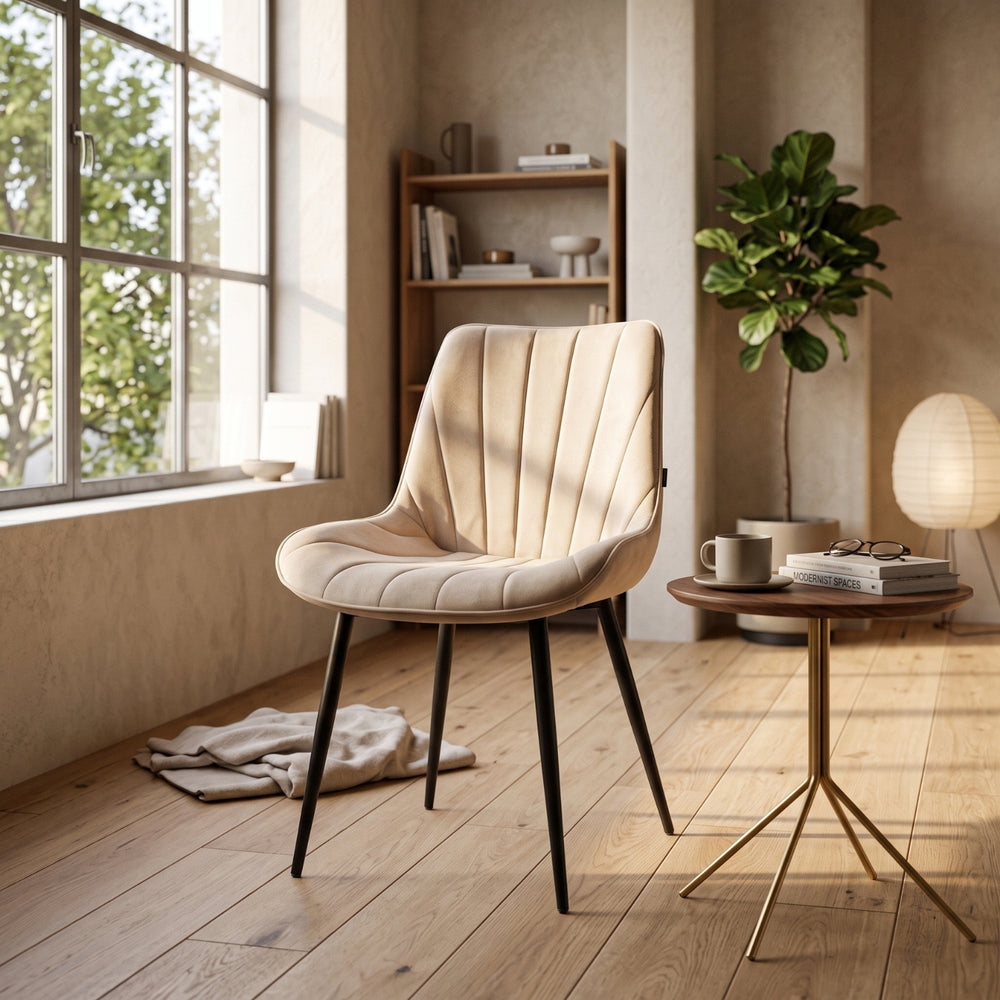
Combining dining chairs in different colours works best when you first decide what will stay the same. For example, use one chair model in two colours, or repeat the same leg colour across different shapes. Then give each colour a clear place at the table. This lets you vary the look without starting from scratch with every chair.
Below are four colour plans developed for different rooms. They are styling suggestions, rather than fixed rules. The colour blocks in the diagrams are illustrative; for the actual shade and texture, look at product photographs and, where possible, a physical swatch. Check chair dimensions separately before ordering a combination.

Start with the elements that are already fixed
Your table, floor and large cabinet are likely to change less often than an accessory. First take a photograph showing these elements together. Note the main colours: for example, light wood, an off-white wall and black metal. Also describe whether the table has a strong grain or a quieter appearance.
Next choose which element should attract attention. With a strongly patterned tabletop, you might limit the chair colours. In a room with understated walls, a row of coloured chairs can become the accent. This is a choice about composition: you distribute attention around the room rather than making every element equally prominent.
Keep two features the same to begin with
For a manageable first combination, keep the model and leg colour the same and vary only the upholstery colour. If you want different models, choose a shared upholstery colour and similar bases, for example. You do not have to keep this approach forever; it simply makes the initial selection easier.
Look at the entire chair, including its back. From the living room, you may mainly see a row of backrests. A combination that works in individual product photos can look different as a group. Lay the photographs side by side in the order the chairs will occupy at the table.

Colour plan 1: beige and green with light wood
For a light dining area with a wooden table, use beige as a quiet base and repeat green in a limited number of places. Suppose you want six chairs that fit: four beige chairs along the long sides and two green ones at the ends give the accent a clear position. First check that there is genuinely usable seating space at those ends.
The Lesedi in beige velvet and the green Lesedi in velvet show how one model can create a colour contrast. Compare the current photographs of both versions; the distribution in the diagram is a layout idea, rather than a representation of exact fabric colours.


You could echo the green in one existing detail, such as artwork or a plant, but do not automatically add the same colour everywhere. Once the arrangement is in place, see whether the chairs already provide enough connection. At a small table with four chairs, you can place two of each colour opposite one another. That gives a different distribution from two accent chairs side by side on one side.
Colour plan 2: beige and black with an understated tabletop
A beige-and-black combination creates a clear distinction between light and dark areas. It can suit a room where black already appears in a lamp, window frame or cabinet handle. Use the existing black elements as your starting point; you do not need to make every new piece of furniture black.
Within the same range, compare the beige Lesedi with the black Lesedi, for example. A shared shape keeps the row visually consistent. With six chairs, you could place the darker colour at both ends. With four chairs, try a symmetrical arrangement and then a second version with two dark chairs on the most visible side.
Assess this arrangement from the place where you most often see the dining area. A dark backrest at the front of the space draws more attention than the same chair behind the table. If the overall effect feels too heavy, change the distribution before adding a third colour.

Colour plan 3: petrol blue and beige in an open-plan room
In an open room, the dining area does not need exactly the same colour distribution as the seating area. You can carry over one existing shade from the living room and combine it with a quiet base. Petrol blue can connect with a blue-green detail elsewhere in the space, while beige links to light walls or textiles.
Look at the Lesedi in petrol blue velvet beside the beige version. Test two plans using the same quantities: petrol blue at the ends and petrol blue in the middle of the long sides. The difference is where the accent sits, rather than how much colour you buy.


Consider the evening view too. You are choosing the combination for your room, not just for the screen you order from. Make a small selection of two colours and place the available photographs or swatches beside your tabletop. Comparing on a screen helps organise your choices, but cannot replace assessing colour in person.
Colour plan 4: green and black for a more distinctive dining area
If you want the chairs to play a more prominent role in the interior, you can combine two darker colours. Green and black are one suggestion for a room with light walls and an understated floor. Keep the distribution deliberately simple: a repeated pair, or one colour along the long sides and the other at the ends.
With this arrangement, the amount of daylight does not guarantee whether the result will feel light or dark. Look at the colour blocks together with the table, backrests and bases. A large black cabinet immediately behind a row of black chairs creates a different effect from a light wall. Use the photograph of your own room as the background for comparison.
You can start with the green and black Lesedi. Like the colour plan but find that the model does not fit your table? First find a model that fits, then rebuild the colour combination using the versions actually available.
| Colour plan | Possible starting point | First arrangement to test |
|---|---|---|
| Beige + green | Light wood and understated walls | Green at both ends |
| Beige + black | Black details and a quiet tabletop | Black as two matching accents |
| Beige + petrol blue | A blue-green detail in the living room | Petrol blue opposite itself |
| Green + black | A dining area that can take more attention | A repeated pair or one colour per side |
Try the arrangement before choosing more colours
Draw your table from above and give each chair a colour. Make three versions using the same quantities. First put the accent colour at the ends, then opposite itself, then side by side. See which layout best suits the sightlines in your room. A symmetrical arrangement may feel calm, but you can depart from it if the room itself is asymmetrical.

Use the actual seat positions. An arrangement with two end chairs only works if the base, legs and chair width allow it. Use the guide to how many chairs fit at your table to check. This colour plan does not add extra seats to a table that is too small.
Combining different models
Want armchairs at the ends and more compact chairs along the sides? Compare backrest height, external width and leg shape as well as colour. Place the product photographs side by side at roughly the same scale. A lower model is more likely to disappear behind the tabletop; a tall back becomes more noticeable in the view from the room.
For each model, check that the armrests and legs fit. Keep colour as a separate choice alongside that measurement checklist. This prevents a beautiful pairing from working only on paper. The detailed dining chair buying guide covers fit.
Make an order list by colour and version
Write down the exact model name, colour, upholstery and quantity. Beige velvet and beige microfibre are different versions; a shared colour name does not prove that shade or texture is identical. Use the fabric comparison if you are still unsure about upholstery.
Check the selling unit too. If a version is sold as a set, your colour plan needs to work with the quantities you can actually order. Check the current product page and basket before paying. Avoid a plan that requires a single accent chair until you know whether that version is sold individually.
- Choose no more than two colours for your first plan.
- Decide which features will stay the same.
- Draw a top view showing the actual seat positions.
- Look at the whole arrangement from the door and the seating area.
- Check dimensions, upholstery, selling units and quantities for each version.
- If unsure, ask Colenis for further information.
Frequently asked questions
How many dining chair colours can I combine?
There is no compulsory maximum. Two colours make a manageable start because their distribution is easy to compare. Add a third only when you know what role it will play in the room.
Do the chairs have to be the same model?
No. Using the same model makes comparing colours easy, but different shapes can work together too. Repeat the leg colour or upholstery, for example, and check each model's dimensions separately.
Where should I put two accent chairs?
The ends are one option, provided there is room. You can also place them opposite one another along the long sides. Compare the options from the main viewing direction in the room.
Does beige always suit a wooden table?
You cannot tell from the colour name alone. Look at the specific beige beside the wood tone, floor and lighting. Photographs or available swatches of your version tell you more than a general colour name.
Can I use velvet and microfibre in one arrangement?
You can if you like the difference in appearance. Assess colour and surface separately, and follow the care information for each version. The same model does not make different upholsteries identical.
What if my colour plan does not match the set size?
Change the distribution or ask whether the version you want is available in a different quantity. Check before ordering; a price per chair does not automatically mean you can buy one chair individually.
Build your combination
Browse the Colenis dining chairs and start with one model that fits. Then select two colours and compare different placements. A clear colour plan makes choosing easier, while your table and daily use set the practical limits.


