

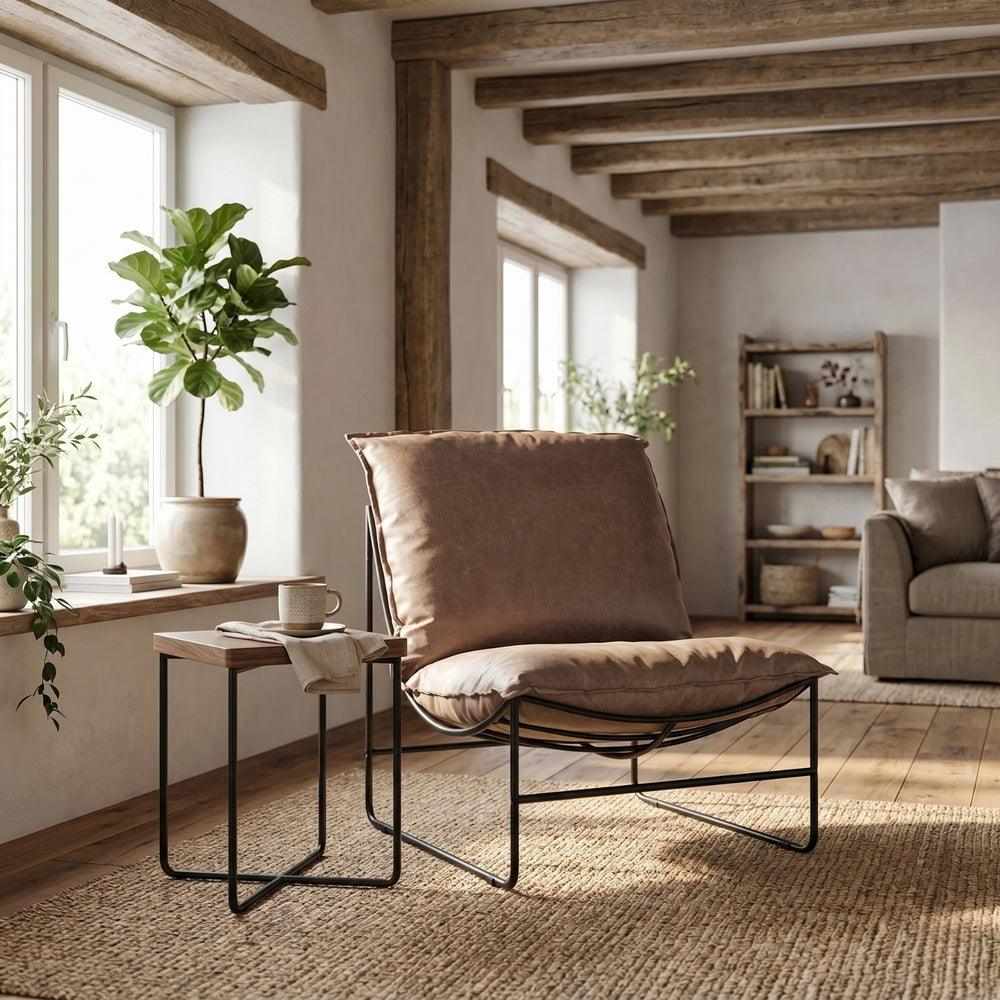
A good reading corner starts with an armchair in a spot you genuinely want to use. First consider the light, the route through the room and the space for your legs. Then add a lamp and a small table. This makes the corner more than a pretty picture: you can sit down, put your book aside and get up again without moving furniture.
This guide takes you from an empty spot to a complete arrangement. The examples are schematic layouts, rather than measured product tests. Use the external dimensions of your chosen armchair for your own plan and try the movements yourself. A quiet corner beside the sofa needs a different approach from a narrow strip in front of a window.

Choose the spot around an ordinary day
First walk through the living room without moving anything. Where do you pass on your way to the kitchen? Which cupboard is opened often? Where does daylight fall on a book, and which spot feels pleasant in the evening? An empty corner only makes a good reading corner if it also fits these daily movements.
Write down when you usually read. For fifteen minutes with the newspaper, a place near the main seating area may work well. For a long chapter, you might prefer less activity around you. Choose your view too: into the room, at an angle past a window or towards a quiet wall. This is a personal preference, rather than a fixed interior design rule.
Look at the corner from two directions
Sit on an existing chair in the intended spot. Then look at that same spot from the doorway. From the armchair, you assess the light and view; from the door, you see whether the chair closes off the room. In an open space, the back of the armchair is part of the interior. Include it in your choice.
Measure the whole reading corner, not just the armchair
Use the armchair's overall width and depth. Seat width describes only the part you sit on. Armrests, a sloping back and projecting legs may determine the external dimensions. Ask about missing measurements before committing to a tight layout.
Mark the footprint with suitable masking tape or lay down loose strips of paper. Add the side table and lamp base. Then sit down and stand up again. Mark where your feet go during that movement. Have someone else walk the usual route through the room while you are seated. This tests the arrangement as you use it, rather than just as it appears on a floor plan.

| Item | What do you draw? | What do you try? |
|---|---|---|
| Armchair | The overall width and depth | Sitting, standing up and moving your legs |
| Side table | Both top and base | Putting down a book from your sitting position |
| Reading lamp | Base, arm and reach of the shade | Reaching the controls and directing the light |
| Cupboard or door | The complete opening movement | Opening it without moving furniture |
| Walkway | The passage you actually use | Walking past while the armchair is occupied |
A small worked example
Suppose your available section of wall is 160 cm wide. An imaginary armchair takes up 80 cm and the side table top is 35 cm wide. Together, that is 115 cm. The remaining 45 cm is not automatically a passage: the position of the table base, gaps between furniture and projecting lamp parts still have to fit. Mark out the individual items on the floor first.
Depth matters too. A chair that fits exactly between a wall and coffee table when empty may leave too little space when you stand up. Add a separate area for use in front of the chair to your sketch. Determine its size with the people who will use the corner.
Test daylight and a reading lamp separately
A spot by the window may be pleasant during the day, but try it at the time you usually read. Put an ordinary book on your lap and look at the page. Turn the chair slightly if direct light or a reflection on a glossy page bothers you. Remember to check that you can still use the curtains and window normally.
In the evening, an adjustable lamp helps direct light onto your book. A movable arm and shade help direct the beam onto the book. The point here is the principle; which lamp suits your armchair depends on the seat height, position and your preferences.

Try the lamp while seated. Can you read the page without your head or hand interrupting the light awkwardly? Are you looking directly at the light source? Can you reach the switch? Move or aim the lamp until these three points work for you. A beautiful lamp that constantly needs moving is less practical in this corner.
Add atmosphere once the reading setup works
You do not have to choose between a cosy room and light on your book. Assess the reading lamp alongside the lighting you normally use in the evening. This avoids testing the corner only with every ceiling light on and then using a completely different setup at home. Choose a dimmable combination only if the manufacturer confirms that the lamp, bulb and any dimmer are compatible.
Which armchair suits the way you read?
A photograph tells you plenty about the shape, but little about how you will sit in the chair with a book. Pay attention to seat depth, back shape and armrests. Do you mainly want to read upright, or do you prefer leaning further back? Do you hold a light book or prefer resting a heavy one on your lap? Try your actual reading position, rather than just sitting briefly.
According to its product description, the Colenis Sofa Relax in Sand has separate seat and back cushions in a metal frame. Look at the side view to assess the relationship between the frame, cushions and back. The name ‘Relax’ does not by itself mean that a model is electrically adjustable or has an extending footrest. Check such functions explicitly if you want them.


Take the same approach with the dark brown version. Colour can change the atmosphere; assess the usefulness of your corner using the actual dimensions and functions. Browse the Colenis armchairs for the current range.
Give your book a regular place within reach
Choose the side table from the armchair. Hold your arm as you would when putting something down and see where your hand naturally lands. A table may look attractive beside the armrest in a photo, yet still feel far away from a deep seat. Test this first with an existing small table or a sturdy temporary surface at the intended height.
Think about everything you want to put down: a book, glasses, a cup and perhaps a tablet. If the top only has room for the lamp base, there is no useful place left to set things. A wall lamp can keep the top free, while a floor lamp does not need fixing to the wall. Remember to include the floor space needed for that lamp's base in the sketch.
Start with few accessories. A single cushion or throw may be enough to connect the armchair with the rest of the room. Add a storage basket only if it has a clear purpose and leaves movement in front of or beside the chair unobstructed.
Three layouts to try at home

Beside the window
First place the armchair at a slight angle to the window and assess the light. Put the table on the side where you can reach it easily. Keep access to the window handle and curtain clear. Finalise the lamp position only after sitting there during both the day and evening. Pushing a chair tightly into the corner is not automatically the most pleasant solution.
At the end of the seating area
Position the armchair so conversation with someone on the sofa is possible, but turn it slightly away from the busiest sightline for reading if you wish. For example, repeat the metal colour of the coffee table to connect the arrangement. Pay particular attention to the space between the front of the armchair and the coffee table; sitting and walking past often overlap there.
In a compact room
Choose the most important function first. An armchair, footstool, large lamp and wide bookcase may together need more space than the corner offers. Start with the chair, directed lighting and a small place to put things. Once the corner works well, assess whether anything else can fit. A smaller accessory only helps if its base and use also need less space.
Check the corner before ordering
- Record the armchair's overall external dimensions and relevant seat measurements.
- Mark the chair, lamp base and table top on the floor.
- Test the route past the corner with someone seated.
- Open nearby doors, drawers and curtains.
- Read in the spot in daylight and with your evening lighting.
- Check that your book and lamp controls are comfortably within reach.
- Ask Colenis about any missing product dimensions or functions.
Then take a photograph from the doorway. This helps you compare colours and shapes, while your measurements keep the practical choice on track. You need both: a corner you like looking at and an arrangement that suits your daily movements.
Frequently asked questions
How much space do I need for a reading corner?
That depends on the armchair's external dimensions, your movement when standing up and your chosen lamp and table. There is no fixed floor area that makes every arrangement fit. Mark all the items and the area needed to use them on the floor.
Does a reading chair have to stand by the window?
No. Choose a place where you enjoy sitting and can light your book well. Near a window, test the actual light and keep window and curtain controls accessible.
Can an armchair fit in a small living room?
A workable arrangement is often possible, but check the whole setup. Depth, projecting legs and room to stand up may matter more than width alone. Start with few separate accessories.
Which side of the armchair is best for a reading lamp?
Try both sides while seated with your own book. Choose a position where light reaches the page, your own shadow does not get in the way and you are not looking directly at the light source.
Do I need a footstool?
Only if you like using one and there is room for it in use. Include it on your floor plan. A footstool that constantly blocks the walkway can make the whole corner less useful.
Should the armchair match the sofa's colour?
It does not have to. You can create a connection through a shared shade, similar material or the same metal in the frame. Look at the combination in the whole room before adding more accent colours.
Turn your favourite spot into a reading corner
Browse the Colenis armchairs with your floor plan to hand. Compare shape, available colours and stated dimensions. The best candidate is the one that makes your corner work well, during the day and in the evening.


